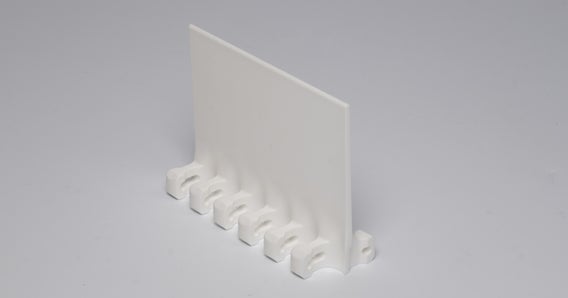
Radius Flush Grid (2.6) with Insert Rollers
Series 2200Ensure safe product accumulation with the Intralox Series 2200 Radius Flush Grid (2.6) with Insert Rollers belt.
This belt features acetal rollers that enable damage-free product accumulation. Its large open area provides quick drainage, and its modular plastic design ensures straightforward installation and maintenance.
- 50% open area offers enhanced cleanability
- Rollers can be staggered or inline
- Minimum turn radius of 2.6 times belt width for belts wider than 16 in (406 mm)
- Suitable for straight-running and radius applications
| in | mm | |
| Pitch | 1.50 | 38.1 |
| Minimum Width | 7 | 178 |
| Width Increments | 1.00 | 25.4 |
| Opening Size (approximate) | 0.50 × 0.75 | 12.7 × 19.7 |
| Open Area | 50% | |
| Hinge Style | Open | |
| Rod Retention; Rod Type | Occluded edge; unheaded | |
- This belt has pinch points. See the Safety section in the Intralox Conveyor Belting Installation, Maintenance & Troubleshooting Manual for more information.
- Contact Intralox for precise belt measurements and stock status before designing equipment or ordering a belt.
- Flush edge or tabbed edge available.
- Uses acetal rollers.
- Each belt material has a default rod material. Other rod materials are available. Intralox can help identify the best belt and rod material combination for your application.
- Detailed material information is provided in Product Line.
- For applications where low back-pressure accumulation is required. Product accumulation load is 5% to 10% of product weight.
- For low back-pressure applications, place wearstrips between rollers. For driven applications, place wearstrips directly under rollers.
- If a standard edge or tabbed edge wearstrip is used to hold the belt in place, do not retain sprockets on the shaft. In this case, the wearstrip maintains the lateral belt position.
- Tab edge belt width does not include tabs. (Tabs extend approximately 0.5 in (13 mm) × 0.25 in (6 mm) on each side of belt.)
- Belts 16 in (406 mm) wide and less have a turn radius of 2.2 times the belt width. Wider belts have a turn radius of 2.6 times the belt width.
- For belts wider than 24 in (610 mm), contact Intralox Customer Service.
- Do not place sprockets inline with rollers.
- Minimum roller indent: 2.5 in (63.5 mm).
- Standard roller spacing:
- across width: staggered 4 in (102 mm) or inline 2 in (51 mm), 3 in (76 mm), or 4 in (102 mm).
- along length: staggered 1.5 in (38.1 mm) or inline 3 in (76.2 mm).
- Custom roller placement is available.

| Belt Material | Default Rod Material, Diameter 0.24 in (6.1 mm) | Straight Belt Strength | Roller Indents | Curved Belt Strength | Temp. Range (continuous) | Belt Mass | |||||||||
|---|---|---|---|---|---|---|---|---|---|---|---|---|---|---|---|
| Roller Width Spacing | |||||||||||||||
| 2 in | 51 mm | 3 in | 7.6 mm | 4 in | 102 mm | ||||||||||
| lbf/ft | N/m | lbf/ft | N/m | lbf/ft | N/m | in | mm | °F | °C | lb/ft² | kg/m² | ||||
| Polypropylene | Acetal | 400 | 5,840 | 710 | 10,400 | 900 | 13,100 | 2.5, 3.5 to 4.5 | 64, 89 to 114 | For curved belt strength calculations, contact Intralox Customer Service. | 34 to 200 | 1 to 93 | 1.86 | 9.08 | |
| Acetal | Nylon | 630 | 9,190 | 1,110 | 16,200 | 1,410 | 20,600 | 2.5, 3.5 to 4.5 | 64, 89 to 114 | -50 to 200 | -46 to 93 | 2.82 | 13.8 | ||
| Polypropylene | Polypropylene1 | 350 | 5,110 | 620 | 9,050 | 790 | 11,500 | 2.5, 3.5 to 4.5 | 64, 89 to 114 | 34 to 220 | 1 to 104 | 1.78 | 8.69 | ||
Polypropylene rods can be installed in polypropylene belts when extra chemical resistance is required. Please note lower belt strength.