Accelerate cleaning with the Intralox Series 2200 Radius Flush Grid belt.
The S2200 Radius Flush Grid belt has a large open area for quick drainage, and its modular plastic design ensures straightforward installation and maintenance. Versatile and dependable, this belt adds value across a range of applications.
- 50% open area offers enhanced cleanability
- 0.75-in (19.1-mm) thick modules accommodate heavy loads
- Available in polypropylene, polyethylene, or acetal
- Minimum turn radius of 2.2 times belt width
- Suitable for straight-running and radius applications
| in | mm | |
| Pitch | 1.50 | 38.1 |
| Minimum Width | 5 | 127 |
| Width Increments | 1.00 | 25.4 |
| Opening Size (approximate) | 0.50 × 0.75 | 12.7 × 19.7 |
| Open Area | 50% | |
| Product Contact Area | 37% | |
| Hinge Style | Open | |
| Rod Retention; Rod Type | Occluded edge; unheaded | |
- This belt has pinch points. See the Safety section in the Intralox Conveyor Belting Installation, Maintenance & Troubleshooting Manual for more information.
- Contact Intralox for precise belt measurements and stock status before designing equipment or ordering a belt.
- Flush edge or tab edge available.
- Belt openings pass straight through the belt to simplify cleaning.
- Lightweight, strong belt with a smooth surface grid.
- Each belt material has a default rod material. Other rod materials are available. Intralox can help identify the best belt and rod material combination for your application.
- Detailed material information is provided in Product Line.
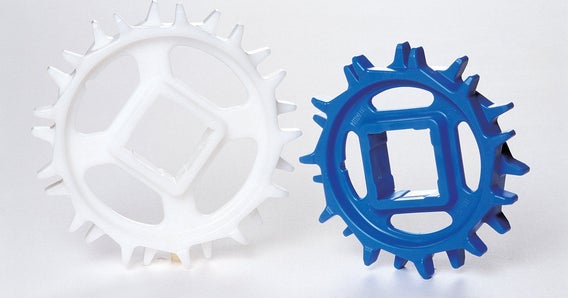
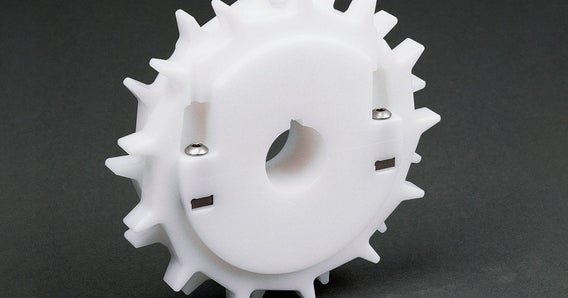
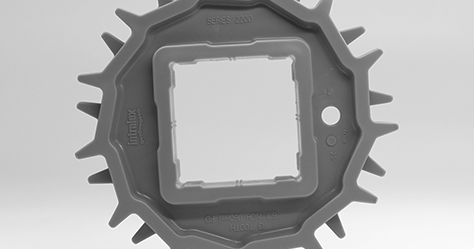
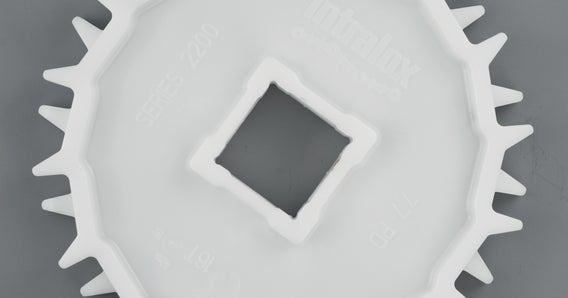
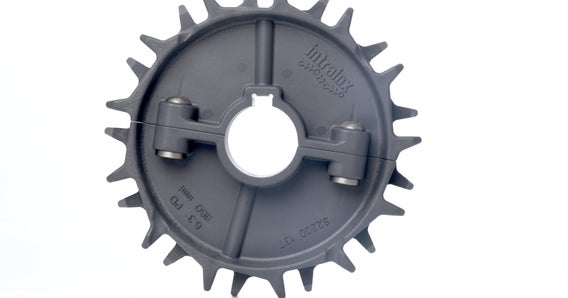
- Non-sliding drive system reduces belt and sprocket wear, and provides low back tension.
- Designed for radius applications with a minimum turn radius of 2.2 times belt width (measured from inside edge).
- If a standard edge or tabbed edge wearstrip is used to hold the belt in place, do not retain sprockets on the shaft. In this case, the wearstrip maintains the lateral belt position.
- Tab edge belt width measurement does not include tabs. Tabs extend approximately 0.5 in (13 mm) × 0.25 in (6 mm) on each side of belt, inside wearstrip.
- Maximum belt width in turns: 36 in (914 mm)

| Belt Material | Default Rod Material, Diameter 0.24 in (6.1 mm) | Straight Belt Strength | Curved Belt Strength | Temperature Range (continuous) | Belt Mass | ||||
|---|---|---|---|---|---|---|---|---|---|
| lbf/ft | N/m | °F | °C | lb/ft² | kg/m² | ||||
| Polypropylene | Acetal | 1,600 | 23,400 | For curved belt strength calculations, contact Intralox Customer Service. | 34 to 200 | 1 to 93 | 1.86 | 9.10 | |
| Polyethylene1 | Acetal | 1,000 | 14,600 | -50 to 150 | -46 to 66 | 1.96 | 9.56 | ||
| Acetal | Nylon | 2,500 | 36,500 | -50 to 200 | -46 to 93 | 2.82 | 13.80 | ||
| Polypropylene | Polypropylene2 | 1,400 | 20,400 | 34 to 220 | 1 to 104 | 1.78 | 8.69 | ||
Polyethylene cannot exceed 150°F (66°C)
Polypropylene rods can be installed in polypropylene belts when extra chemical resistance is required. Please note lower belt strength.
| Document Name | Document Type | File Type | File Size |
|---|---|---|---|
| S2200_FlushGrid_FlushEdge_[SideView]_(Imperial).dxf | CAD Drawing | DXF | 274 KB |
| S2200_FlushGrid_FlushEdge_[SideView]_(Metric).dxf | CAD Drawing | DXF | 276 KB |
| S2200_FlushGrid_FlushEdge_[TopView]_(Imperial).dxf | CAD Drawing | DXF | 424 KB |
| S2200_FlushGrid_FlushEdge_[TopView]_(Metric).dxf | CAD Drawing | DXF | 434 KB |
| S2200_FlushGrid_TabbedEdge_[SideView]_(Imperial).dxf | CAD Drawing | DXF | 328 KB |
| S2200_FlushGrid_TabbedEdge_[SideView]_(Metric).dxf | CAD Drawing | DXF | 336 KB |
| S2200_FlushGrid_TabbedEdge_[TopView]_(Imperial).dxf | CAD Drawing | DXF | 502 KB |
| S2200_FlushGrid_TabbedEdge_[TopView]_(Metric).dxf | CAD Drawing | DXF | 514 KB |