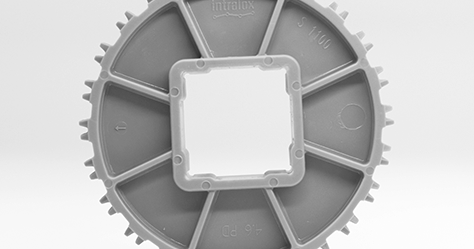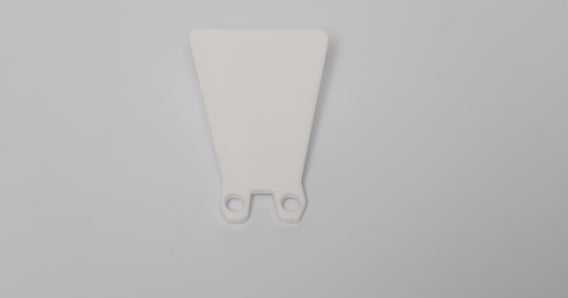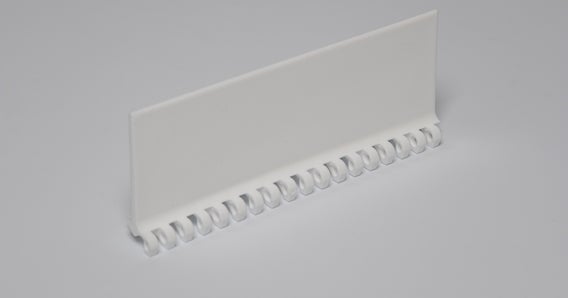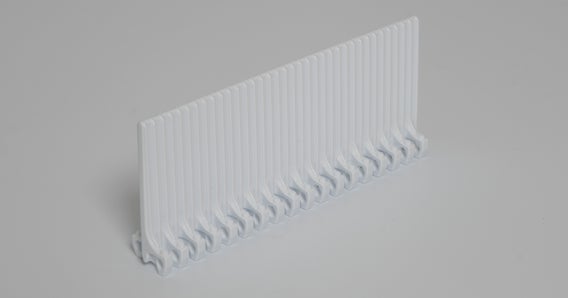
Achieve seamless transfers across a variety of applications with the Intralox Series 1100 Flush Grid belt.
Used especially in canmaking and bakery, S1100 Flush Grid belting’s no-tip surface handles even the most challenging items. It features a small pitch that guarantees smooth transfers of difficult items, including lightweight containers and tall, sleek, or slim cans.
- 0.60-in (15.2-mm) pitch reduces chordal action
- 0.875-in (22.2-mm) diameter nosebars for tight transfers
- Suited for both front-end and back-end can lines
- No-tip surface minimizes tippage and label mix-ups
| in | mm | |
| Pitch | 0.60 | 15.2 |
| Minimum Width | See Product Notes. | |
| Width Increments | ||
| Minimum Opening Size (approximate) | 0.17 × 0.10 | 4.3 × 2.5 |
| Maximum Opening Size (approximate) | 0.31 × 0.10 | 7.9 × 2.5 |
| Open Area | 28% | |
| Hinge Style | Open | |
| Rod Retention; Rod Type | Occluded edge; unheaded | |
- Contact Intralox for precise belt measurements and stock status before designing equipment or ordering a belt.
- Lightweight with smooth surface grid.
- Small pitch reduces chordal action and the gap required at the transfer dead plate.
- Custom-built in widths that vary by material.
- Acetal and polypropylene are available in widths from 3 in (76 mm) and up, in 0.5 in (12.7 mm) increments.
- Flame retardant thermoplastic polyester (FR TPES) is available in widths from 5 in (127 mm) and up, in 1.0 in (25.4 mm) increments.
- All other materials are available in widths 3 in (76 mm) and up, in 1.0 in (25.4 mm) increments.
- Each belt material has a default rod material. Other rod materials are available. Intralox can help identify the best belt and rod material combination for your application.
- Detailed material information is provided in Product Line.
- For information regarding sprocket placement, see the center sprocket offset table in Locked Sprocket Position on Shaft.
- Can be used over 0.875 in (22.2 mm) diameter nosebar for tight transfers.

| Belt Material | Default Rod Material, Diameter 0.18 in (4.6 mm) | Belt Strength | Temperature Range (continuous) | Belt Mass | |||
|---|---|---|---|---|---|---|---|
| lbf/ft | N/m | °F | °C | lb/ft² | kg/m² | ||
| Polypropylene | Polypropylene | 700 | 10,200 | 34 to 220 | 1 to 104 | 0.81 | 3.95 |
| Polyethylene | Polyethylene | 450 | 6,570 | -50 to 150 | -46 to 66 | 0.87 | 4.25 |
| Acetal | Polypropylene | 1,300 | 19,000 | 34 to 200 | 1 to 93 | 1.19 | 5.80 |
| HSEC acetal | Polypropylene | 800 | 11,700 | 34 to 200 | 1 to 93 | 1.19 | 5.80 |
| FR TPES | Polypropylene | 750 | 7,355 | 40 to 150 | 4 to 66 | 1.30 | 6.34 |
| HHR nylon | HHR nylon | 1,100 | 14,600 | -50 to 310 | -46 to 154 | 1.14 | 5.57 |
| HR nylon | Nylon | 1,100 | 14,600 | -50 to 240 | -46 to 116 | 1.07 | 5.22 |
| UV resistant polypropylene | UV resistant polypropylene | 700 | 10,200 | 34 to 220 | 1 to 104 | 0.81 | 3.98 |
| Detectable polypropylene A22 | Polypropylene | 450 | 4,413 | 0 to 150 | -18 to 66 | 1.04 | 5.08 |
| Acetal1 | Polyethylene | 1,200 | 17,500 | -50 to 70 | -46 to 21 | 1.19 | 5.80 |
| UVFR | PVDF | 700 | 10,200 | -34 to 200 | 1 to 93 | 1.57 | 7.67 |
| PK | PK | 1,300 | 19,000 | -40 to 176 | -40 to 80 | 1.04 | 5.08 |
Polyethylene rods can be used in cold applications when impacts or sudden starts/stops occur. Please note lower rating.
| Document Name | Document Type | File Type | File Size |
|---|---|---|---|
| PK Belt Material Product Highlight | 444 KB | ||
| S1100_FlushGrid_FlushEdge_2inch_(Imperial).dxf | CAD Drawing | DXF | 275 KB |
| S1100_FlushGrid_FlushEdge_2inch_(Metric).dxf | CAD Drawing | DXF | 285 KB |
| S1100_FlushGrid_FlushEdge_4.5inch_(Imperial).dxf | CAD Drawing | DXF | 563 KB |
| S1100_FlushGrid_FlushEdge_4.5inch_(Metric).dxf | CAD Drawing | DXF | 587 KB |
| S1100_FlushGrid_FlushEdge_4inch_(Imperial).dxf | CAD Drawing | DXF | 511 KB |
| S1100_FlushGrid_FlushEdge_4inch_(Metric).dxf | CAD Drawing | DXF | 530 KB |
| UVFR Belt Material Product Highlight | 807 KB |