Confidently transport a variety of products with our versatile, dependable belting.
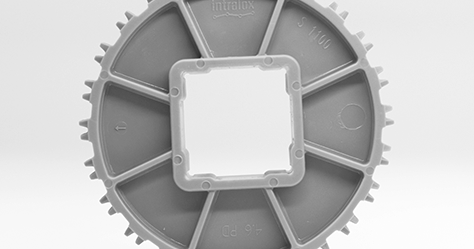
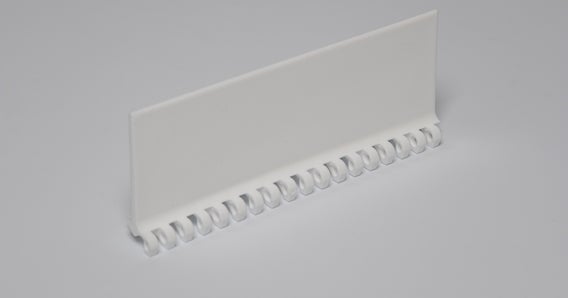
From canmaking to food processing, Intralox Series 1100 Flat Top belting adds value across industries. Its closed surface prevents product loss, while its small pitch guarantees tight transfers.
- Lightweight with smooth surface
- 0.60-in (15.2-mm) pitch reduces chordal action
- 0.875-in (22.2-mm) diameter nosebars
| in | mm | |
| Pitch | 0.60 | 15.2 |
| Minimum Width | 3 | 76 |
| Width Increments | 1.00 | 25.4 |
| Opening Size | - | - |
| Open Area | 0% | |
| Hinge Style | Open | |
| Rod Retention; Rod Type | Occluded edge; unheaded | |
- Contact Intralox for precise belt measurements and stock status before designing equipment or ordering a belt.
- Small pitch reduces chordal action and the gap required at the transfer dead plate.
- Lightweight with smooth, closed surface grid.
- Each belt material has a default rod material. Other rod materials are available. Intralox can help identify the best belt and rod material combination for your application.
- Detailed material information is provided in Product Line.
- For information regarding sprocket placement, see the center sprocket offset table in Locked Sprocket Position on Shaft.
- Can be used over 0.875 in (22.2 mm) diameter nosebar for tight transfers. See Tight-Transfer Methods for more information.

| Belt Material | Default Rod Material, Diameter 0.18 in (4.6 mm) | Belt Strength | Temperature Range (continuous) | Belt Mass | |||
|---|---|---|---|---|---|---|---|
| lbf/ft | N/m | °F | °C | lb/ft² | kg/m² | ||
| Polypropylene | Polypropylene | 5001 | 4,9031 | 34 to 220 | 1 to 104 | 0.90 | 4.40 |
| Polyethylene | Polyethylene | 3001 | 2,9421 | -50 to 150 | -46 to 66 | 0.96 | 4.69 |
| HR nylon | Nylon | 500 | 4,903 | -50 to 240 | -46 to 116 | 1.15 | 5.61 |
| HHR nylon | HHR nylon | 800 | 7,845 | -50 to 310 | -46 to 154 | 1.175 | 5.74 |
| Acetal | Polypropylene | 1,000 | 14,600 | 34 to 200 | 1 to 93 | 1.30 | 6.35 |
| Acetal2 | Polyethylene | 900 | 8,826 | -50 to 70 | -46 to 21 | 1.30 | 6.35 |
| X-ray detectable acetal | X-ray detectable PK | 800 | 11,700 | -50 to 200 | -46 to 93 | 1.6 | 7.81 |
| Detectable polypropylene A22 | Polypropylene | 300 | 2,942 | 0 to 150 | -18 to 66 | 1.09 | 5.32 |
| PK | PK | 1,000 | 14,600 | -40 to 176 | -40 to 80 | 1.14 | 5.57 |
When using steel split sprockets, the belt strength for polypropylene is 400 lbf/ft (5,840 N/m): polyethylene is 240 lbf/ft (3,500 N/m)
Polyethylene rods can be used in cold applications when impacts or sudden starts/stops occur. Please note lower rating.
| Document Name | Document Type | File Type | File Size |
|---|---|---|---|
| PK Belt Material Product Highlight | 444 KB | ||
| S1100_FlatTop_FlushEdge_2inch_(Imperial).dxf | CAD Drawing | DXF | 1 MB |
| S1100_FlatTop_FlushEdge_2inch_(Metric).dxf | CAD Drawing | DXF | 2 MB |
| S1100_FlatTop_FlushEdge_4inch_(Imperial).dxf | CAD Drawing | DXF | 3 MB |
| S1100_FlatTop_FlushEdge_4inch_(Metric).dxf | CAD Drawing | DXF | 4 MB |
| S1100_FlatTop_Interior_6inch_(Imperial).dxf | CAD Drawing | DXF | 6 MB |
| S1100_FlatTop_Interior_6inch_(Metric).dxf | CAD Drawing | DXF | 6 MB |